
Empowered nurses save lives
International Nurses Day 2026
On International Nurses Day 2026, the International Council of Nurses (ICN) is calling for urgent action through this year’s theme: Our Nurses. Our Future. Empowered Nurses Save Lives.
The theme recognises the essential role nurses play in improving and saving lives every day, while highlighting the need for structural change to fully harness the power of the nursing workforce.
ICN emphasises that nurses achieve the greatest impact when they are supported through safe workplaces, leadership opportunities, education, fair working conditions, and the ability to practice to the full scope of their knowledge and skills.
“Nurses play a critical role in health care and are often the unsung heroes in health care facilities and emergency response. They are often the first to detect health emergencies and work on the front lines of disease prevention and the delivery of primary health care, including promotion, prevention, treatment and rehabilitation,” the World Health Organization states, highlighting the profession’s contribution to progressing health-related Sustainable Development Goals (SDGs).
International Nurses Day is celebrated annually on 12 May, the anniversary of the birth of Florence Nightingale. Nightingale is remembered not only as the founder of modern nursing but also as a pioneering statistician and advocate for using evidence to improve care. Her work demonstrated the power of collecting, interpreting, and applying data to reduce mortality and improve patient outcomes—principles that remain central to evidence-based nursing today and closely align with JBI’s mission of promoting evidence-based healthcare to improve global health outcomes.
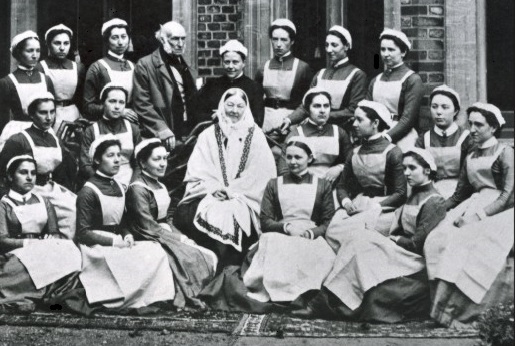
Image: Nightingale Training School for Nurses with Florence Nightingale
Credit: Commons Wikimedia
As global health systems face workforce shortages, increasing care demands, conflict, and climate-related pressures, empowering nurses has become increasingly important. According to the World Health Organisation and ICN, the global nursing workforce reached nearly 30 million in 2023—yet significant inequities in workforce distribution, education, leadership opportunities, working conditions, and well-being support still affect nurses worldwide.
“It is increasingly apparent that sub-Saharan Africa bears the largest proportion of the global burden of disease while at the same time having the smallest number of healthcare providers to tackle this huge burden... The concern here is that because this small and overworked workforce has to fight the largest proportion of the global burden of disease, there is likely to be little impact on health outcomes without intervention.” Dr Clifford Mwita on the findings from the systematic review, Prevalence of burnout among nurses in sub-Saharan Africa: a systematic review.
JBI research continues to contribute to the global conversation around the conditions nurses need to deliver safe, high-quality care. Recent research in JBI Evidence Synthesis has explored nurses’ experiences across topics including nightwork, organisational change, unfinished nursing care, and workplace violence.
Protocols and editorials such as Simulation-based education to support new graduate nurses during transition to practice and Resilience development in nursing students and new nurse graduates highlight the importance of investing in education, mentorship, and workforce support across every stage of a nurse's career.
JBI Evidence Implementation projects also demonstrate how empowering nurses with evidence, education, and implementation support can improve patient outcomes and healthcare quality. Projects published in JBI Evidence Implementation have supported improvements in optimising pain assessment for cancer patients in intensive care, medication administration safety, wound management, falls prevention, and nursing documentation.
Empowering nurses to increase engagement in advance care planning in a medicine transitional care unit demonstrated how supporting nurses to confidently engage in evidence-based conversations strengthened person-centred care practices.
This International Nurses Day, JBI joins the global nursing community in recognising the extraordinary contribution of nurses worldwide. JBI also reinforces the importance of high-quality evidence to support and empower nurses to improve health outcomes, deliver trusted person-centred care, and help address the world’s biggest health challenges.
Additional resources
Improving evidence-based COPD self-management with a decision support system in Finland
Increasing capacity to prevent patient falls in an acute care inpatient setting
Building capacity for evidence-based practice in Guangdong Province, PR China
Evidence-based practice capacity building: a Portuguese experience with undergraduate nursing students
The challenges of international nursing students