From Variation to Consistency: Evidence-Informed Low-Molecular-Weight Heparin Injection Practice in Hong Kong Cardiac Care

A JBI-informed evidence synthesis and cross-cluster implementation initiative is helping Hong Kong cardiac services move from varied local routines toward a more consistent approach to subcutaneous low-molecular-weight heparin (LMWH) injection.
For many cardiac patients, low-molecular-weight heparin is an ordinary part of extraordinary days. It is given during admissions marked by fear and uncertainty, when patients present with acute coronary syndrome, atrial fibrillation, pulmonary embolism, and other cardiovascular conditions requiring anticoagulation. For patients, these injections are not minor details in the admission process; instead, patients may experience repeated pain, bruising, and hematoma at the injection site, which can cause distress and affect the overall experience of care. In rare cases, complications can be serious. Rather than striving to administer LMWH through an optimal procedure, this subcutaneous LMWH injection has instead often been delivered with wide variation in routine practice.
That was the problem our team set out to address. Across cardiac settings, nurses used different injection sites, injection durations, needle withdrawal practices, and post-injection routines. Some injected into the abdomen, while others used the upper arm or thigh. Some withdrew the needle immediately, while others waited briefly. Some compressed the site afterward, while others did not. For patients, this meant that a common treatment could feel very different depending on where they were admitted. For nurses, it meant relying on local custom rather than a shared, teachable, and consistently documented approach.
We set out not to claim a single best technique, but to understand the evidence landscape. Supported by the JBI Hong Kong Centre of Evidence-Based Healthcare Excellence, based at The Hong Kong Polytechnic University, our team conducted an evidence synthesis using JBI methodology to identify and map how subcutaneous LMWH injection techniques had been studied in cardiovascular care. The synthesis examined components of the injection process, including the injection site, injection duration, needle withdrawal timing, injection angle, pressure duration, site rotation, documentation, and cold application. It showed which aspects of injection practice had been empirically examined and where study designs, outcomes, and practice details varied. This mapping clarified why frontline uncertainty persisted: the literature contained useful studies on individual injection elements, but clinical practice still lacked a complete and consistently applied bedside procedure.
This gap presented an opportunity for implementation work. The mapped evidence was used as an important input, alongside cardiac nursing expertise, patient safety priorities, feasibility discussions, and cross-cluster operational consensus, to develop a standardised working procedure for implementation testing. The procedure moved practice away from unwritten habits and toward a teachable and repeatable workflow. It specified abdominal site use where appropriate, vertical needle insertion, a slower and more controlled injection process, a short pause before needle withdrawal, post-injection compression, site rotation, and systematic documentation. It also strengthened documentation by stipulating that nurses mark the first injection site with a transparent dressing, avoid reinjection into the same area, and record injection sites in a consistent manner. These changes may seem technical on paper, but at the bedside, they shape a patient’s experience, a nurse’s actions, and the consistency with which care is delivered.
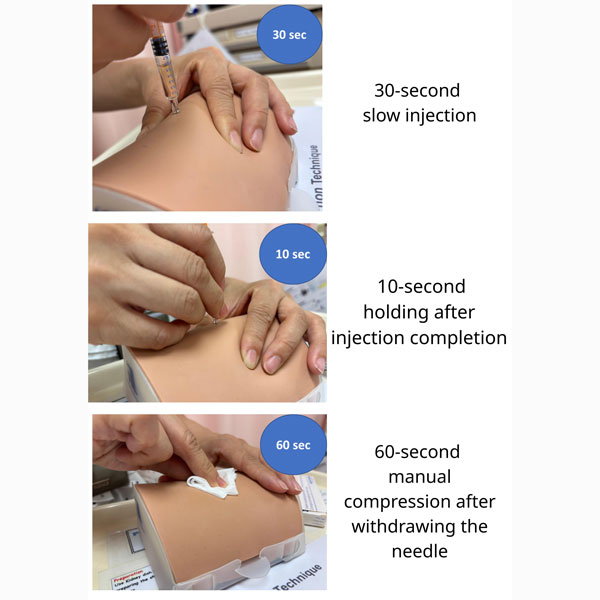
This project was deeply collaborative. It brought together university researchers, Hospital Authority Head Office, the Specialty Advisory Group in Cardiology, and nurses working across seven hospital clusters in Hong Kong. This collaboration was essential because the challenge was not only to locate and organise evidence but also to ensure the resulting procedure could be used in complex real-world cardiac settings. The project therefore included nurse education on the standardised injection technique and research procedures, together with shared workflows, common documentation rules, and aligned data collection processes. In other words, the work did not stop at synthesis; it moved into capability building, service alignment, and implementation testing.
The clinical trial is still ongoing, so this impact story cannot demonstrate final reductions in pain, bruising, or hematoma. Instead, the impact to date is visible through implementation. A previously fragmented area of routine care now has a structured working procedure being tested across multiple hospital settings. Nurses from different clusters are being trained using a common approach rather than relying solely on local custom. Furthermore, documentation and data collection have become more standardised, enabling the team to evaluate practice and outcomes more rigorously. Implementation challenges have also been identified and addressed in real time, which has included clarifying documentation rules, recording the experience level of the administering nurse, capturing the dosage more precisely, and standardising bruise-size calculation. These practical refinements are the groundwork needed for sustainable change and credible outcome evaluation.
Most importantly, this work keeps patients at the centre. JBI impact stories are about people, not just methods or data. In this project, the people are patients whose treatment experience may be improved when avoidable variation is reduced; nurses, who gain clearer guidance, stronger training, and greater confidence in a shared procedure; and health services, which are better able to align routine practice across institutions. This story also centres on respect: respect for patients in the details of everyday care, and respect for frontline clinicians, who deserve clear procedures to support their routine actions at the bedside.
The larger lesson is that evidence-based healthcare is not only a shift transforming major services and bringing in advanced technologies. Sometimes, this shift begins with improving a familiar procedure that takes place many times a day. In this case, JBI methodology did not provide a shortcut from review to recommendation. Its value was different: it helped the team organise the evidence landscape, recognise variation, identify practical areas for standardisation and further evaluation, and build a disciplined pathway from synthesis to implementation testing. That is the impact of evidence in action.
This initiative shows that JBI methodology can support more than knowledge generation. When used carefully, it can help clinical teams map evidence, understand practice variation, align stakeholders, build implementation capacity, and evaluate change in real-world settings. For cardiac patients receiving LMWH injections in Hong Kong, the impact is already taking shape through evidence mapping, protocol development based on clinical and operational consensus, nurse education, cross-cluster collaboration, standardised documentation, and active outcome evaluation.
References:
Wong, A. K. C., Chu, R. Y. K., Nan, Y., Cheng, H., Tong, D., Leung, M., Lam, H., Chiu, S. H., Cheung, H. W., Chan, M. C., Chau, M. Y., Lee, T., Leung, Y. W., Mow, H. C., Wan, S., Wong, L. Y., & Montayre, J. (2025). Injection techniques to reduce adverse effects of subcutaneous low-molecular-weight heparin among patients with cardiovascular diseases: A scoping review. Journal of Advanced Nursing, 81(11), 7361–7373.
JBI Collaboration. (2026). JBI Publications – Impact Story, Case Studies and World EBHC Day Blogs.
Authors:
Prof Arkers Kwan Ching Wong, Prof Jed Montayre and Ms Frankie Cheung