Giving voice to care: 10 years of digital transformation with the Professional Assessment Instrument (PAI)

I still remember the first meeting in late 2012, when our nursing leadership posed a simple but profound question: How can we make nursing visible? Not just as tasks completed or hours logged, but as a clinical discipline capable of influencing outcomes, guiding decisions and documenting complexity with rigour and clarity.

That question marked the beginning of a decade-long journey—one I have had the privilege to walk as a nurse researcher in the Nursing Directorate’s Research Division at Agostino Gemelli University Hospital in Rome, Italy. Our answer took shape through the Professional Assessment Instrument (PAI): a clinical decision support and documentation system designed to standardise nursing language and embed the nursing process into the hospital’s digital ecosystem. Originally developed by a research team at the University of Rome Tor Vergata, the PAI was adopted by our institution for hospital-wide implementation.
A vision takes shape (2013)
The implementation began in early 2013 across five pilot units, including Medical Emergency, Cardiology, Oncology, Sub-Intensive Care and Thoracic Surgery. Before using the system, each nurse underwent dedicated training sessions on the nursing care plan and diagnostic reasoning. We needed to build not just technical competence, but cultural readiness.
Meaningful change requires a quantifiable assessment of the process. We launched a long-term research project to study employee perceptions together with actual system effects and workplace attitudes. The research team gathered data through pre-implementation surveys and post-training focus groups to assess satisfaction levels, usability, perceived benefits and resistance.
The momentum for change became unstoppable at the end of 2013. The second phase of implementation started as the team developed conviction about establishing a nursing identity that combined evidence-based practice with clinical visibility and accountability.
The data revolution in nursing
The PAI operates as both a documentation system and a diagnostic tool that generates clinical understanding. We gained our first ability to measure patient diagnostic complexity through this system. The number of documented nursing diagnoses per patient reached an average of five and this number increased as nurses gained confidence in the system and their clinical judgment skills.
In a 2019 study published in the Journal of Nursing Scholarship, we demonstrated a direct relationship between the number of nursing diagnoses and both length of stay and mortality—a finding that aligned with international evidence and placed nursing data at the heart of outcome prediction.
Other studies confirmed these insights. Nursing diagnoses were shown to enhance risk-adjustment models for hospital mortality and serve as valid proxies for patient complexity in surgical settings. In oncology settings, nursing documentation using a Nursing Minimum Data Set revealed over 25 nursing activities per day per patient, the majority based on independent nursing decisions.
Audit and feedback: Learning from ourselves
From 2015 onwards, we institutionalised the PAI Audit—a structured internal review process grounded in Ministry of Health guidelines and best practices. Each semester, we reviewed documentation completeness, diagnostic accuracy, intervention coherence and outcome tracking.
Since 2021, in collaboration with the Rome Order of Nursing Professionals, we realigned our audit and feedback system with the JBI Evidence Implementation Framework. This shift allowed us to transform routine audits into structured, evidence-informed implementation projects. We drew directly from the JBI Manual for Evidence Implementation to develop our process, particularly the Getting Research into Practice (GRiP) method, and we transformed routine audits into structured implementation projects. The GRiP method guided each phase: baseline audit, identification of barriers, co-design of tailored strategies and re-audit.
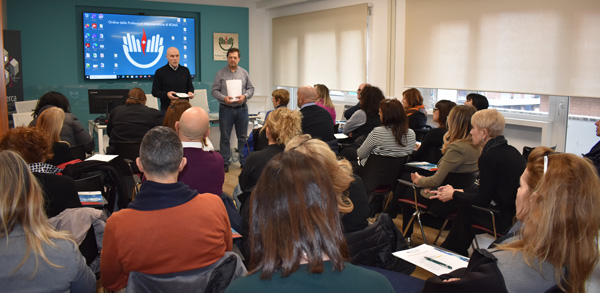
A core element of our approach was a system of transparent monitoring and shared accountability. After each audit cycle, results were presented during dedicated feedback sessions involving nurses and their coordinators. These sessions served not only as moments of reflection but also as educational opportunities during which specific improvement objectives were discussed and assigned. Final reports were shared within each unit and posted visibly on the Quality Board, reinforcing a culture of responsibility, peer learning and professional growth.
Audit criteria were derived using the D-Catch tool and focused on specific dimensions of documentation: the accuracy of nursing assessments (A1, A2), the clarity and appropriateness of nursing diagnoses (D1, D2), the traceability and relevance of outcomes (V1, V2) and the presence of clinical reassessments (RIV), essential for monitoring patient evolution.
This structured approach followed the full JBI audit cycle and was supported by ongoing dialogue with clinical staff. Within a year, documentation completeness improved from 67% to 89%. More importantly, nurses began to view audits not as external controls, but as tools for growth, safety and excellence in care. By embedding JBI methodology into our routine practices, we transformed auditing into a shared professional commitment—and a powerful engine for cultural change.
Paediatric expansion and system evolution
By 2016, the PAI system evolved further. A paediatric version was co-designed with neonatal and paediatric teams, integrating the Clinical Care Classification (CCC) system—an ANA-recognised taxonomy. Implemented across all paediatric units, this new version supported structured documentation for some of our most complex and vulnerable patients.
The integration of CCC enhanced diagnostic precision through 176 nursing diagnoses, developed from studies involving over 40,000 patients. It also ensured that diagnoses, interventions and care activities were explicitly linked—creating an ecosystem for nursing care planning grounded in clinical reasoning and measurable outcomes.
Today, both adult and paediatric versions of the PAI are fully operational, continuously monitored and regularly updated based on user feedback, audit findings and the latest evidence.
Reflections and future directions
What began as a question—how to make nursing care visible—has become a defining element of our professional identity. The PAI program has shown that the language of healthcare shapes practice and that structured, clinician-designed data systems lead to better care and more relevant research.
The application of JBI methodology—particularly audit frameworks and the GRiP method—taught us that evidence-based practice is not a destination, but a cycle: one that begins with measurement, requires reflection and thrives on participation. This mindset continues to guide us as we explore next-generation innovations.
Today, our research team is investigating the integration of AI and predictive analytics, using structured PAI data to support precision nursing. Through each audit, training session and onboarding experience, we are reminded of a fundamental truth: evidence-based care begins with accurate documentation—and evolves through a culture of shared learning.
Key take-home messages
Making nursing visible requires more than technology; it demands cultural transformation, structured data and a shared professional language.
The PAI system enabled nurses to document complexity, support clinical reasoning and link their work to measurable patient outcomes.
The JBI Evidence Implementation Framework played a key role in transforming internal audits into structured implementation projects, guided by the GRiP method.
Evidence-based audit criteria became a tool for growth and learning, helping to embed implementation science into clinical practice.
Integrating AI and predictive analytics into the PAI framework marks the next step in leveraging nursing documentation for precision care.
Evidence-based practice starts with documentation and thrives where reflection, data and collective action meet.
— Narrated by a nurse researcher, Nursing Directorate – Research Area, Fondazione Policlinico Universitario A. Gemelli IRCCS
Reference
Cesare, M., D'Agostino, F., Maurici, M., Zega, M., Zeffiro, V., & Cocchieri, A. (2023). Standardized nursing diagnoses in a surgical hospital setting: A retrospective study based on electronic health data. SAGE Open Nurs, 9, 23779608231158157.
Cocchieri, A., Di Sarra, L., D'Agostino, F., Bravetti, C., Pignocco, M., Vellone, E., . . . Zega, M. (2018). [Development and implementation of pediatric and neonatal nursing information system in an hospital setting: the pediatric PAI]. Ig Sanita Pubbl, 74(4), 315-328. Available from: https://www.ncbi.nlm.nih.gov/pubmed/30767947
D'Agostino, F., Sanson, G., Cocchieri, A., Vellone, E., Welton, J., Maurici, M., . . . Zega, M. (2017). Prevalence of nursing diagnoses as a measure of nursing complexity in a hospital setting. J Adv Nurs, 73(9), 2129-2142.
D'Agostino, F., Vellone, E., Cocchieri, A., Welton, J., Maurici, M., Polistena, B., . . . Sanson, G. (2019). Nursing diagnoses as predictors of hospital length of stay: A prospective observational study. J Nurs Scholarsh, 51(1), 96-105.
D'Agostino, F., Zega, M., Rocco, G., Luzzi, L., Vellone, E., & Alvaro, R. (2013). Impact of a nursing information system in clinical practice: a longitudinal study project. Ann Ig, 25(4), 329-341.
Sanson, G., Alvaro, R., Cocchieri, A., Vellone, E., Welton, J., Maurici, M., . . . D'Agostino, F. (2019). Nursing diagnoses, interventions and activities as described by a nursing minimum data set: A prospective study in an oncology hospital setting. Cancer Nurs, 42(2), E39-E47.
Authors
Cocchieri Antonello, Vanzi Valentina, Stievano Alessandro, Caggianelli Gabriele, Fiorini Jacopo, Nuzzo Carmen, Rocco Gennaro, Zega Maurizio.