
UofA JBI Logo

Main navigation

  • Home
  • About JBI
    • About
      • Work with JBI
      • Annual Reports
      • Our History
    • JBI Model of EBHC
    • JBI Impact Stories
  • Global Networks
    • JBI COLLABORATION
    • GROUPS WE WORK WITH
    • JBI EVIDENCE IMPLEMENTATION NETWORK
    • Scoping Review Network
  • Education
    • Short Courses
      • Rapid Evidence Synthesis: JBI Evidence Summary Workshop
      • Comprehensive Systematic Review Training Program
      • Scoping Review Workshop
      • Evidence Implementation Training Program
      • Evidence Implementation Workshop
      • Clinical Leadership Workshop
    • Postgraduate Research Degrees
      • Doctor of Philosophy
      • Master of Philosophy
    • Tailored Training
  • Products & Services
    • JBI Best Practice
    • Journals
    • Software
    • Consultancy
  • EBP Resources
    • Critical Appraisal Tools
    • JBI Manual for Evidence Synthesis
    • JBI Manual for Evidence Implementation
    • JBI SUMARI Knowledge Base
    • JBI PACES Knowledge Base
    • Research Dissemination Resources
  • NEWS
    • JBI Buzz
  • EVENTS
    • Global Events
    • Solution Room
    • JBI IGNITE
  • Home
  • About JBI
    • About
      • Work with JBI
      • Annual Reports
      • Our History
    • JBI Model of EBHC
    • JBI Impact Stories
  • Global Networks
    • JBI COLLABORATION
    • GROUPS WE WORK WITH
    • JBI EVIDENCE IMPLEMENTATION NETWORK
    • Scoping Review Network
  • Education
    • Short Courses
      • Rapid Evidence Synthesis: JBI Evidence Summary Workshop
      • Comprehensive Systematic Review Training Program
      • Scoping Review Workshop
      • Evidence Implementation Training Program
      • Evidence Implementation Workshop
      • Clinical Leadership Workshop
    • Postgraduate Research Degrees
      • Doctor of Philosophy
      • Master of Philosophy
    • Tailored Training
  • Products & Services
    • JBI Best Practice
    • Journals
    • Software
    • Consultancy
  • EBP Resources
    • Critical Appraisal Tools
    • JBI Manual for Evidence Synthesis
    • JBI Manual for Evidence Implementation
    • JBI SUMARI Knowledge Base
    • JBI PACES Knowledge Base
    • Research Dissemination Resources
  • NEWS
    • JBI Buzz
  • EVENTS
    • Global Events
    • Solution Room
    • JBI IGNITE
 

Breadcrumb

  1. Home
  2. news
  3. article
  4. sampling quality improvement research
Twisted lines entering a cog and clipboard icon and reappearing as straight arrows, representing Quality Improvement

Sampling in quality improvement research

Why clearer guidance is needed

Sampling decisions directly affect the credibility, interpretability, and usefulness of quality improvement data. A scoping review recently examined how sampling methods and sample size considerations are conceptualised and justified within healthcare quality improvement initiatives. It systematically addresses sampling as a distinct methodological issue in quality improvement.

Recognising that quality improvement relies on timely, context-sensitive data rather than traditional statistical inference, the study aimed to identify and synthesise existing sampling strategies, frameworks, and methodological guidance used in quality improvement initiatives, situating these within the broader fields of evidence implementation and implementation science. 

The scoping review found that non-probability sampling methods, particularly judgment, purposive, and convenience sampling, dominate quality improvement practice due to their feasibility and alignment with rapid-cycle improvement approaches such as PDSA. Probability sampling is used selectively when generalisability or benchmarking is required. 
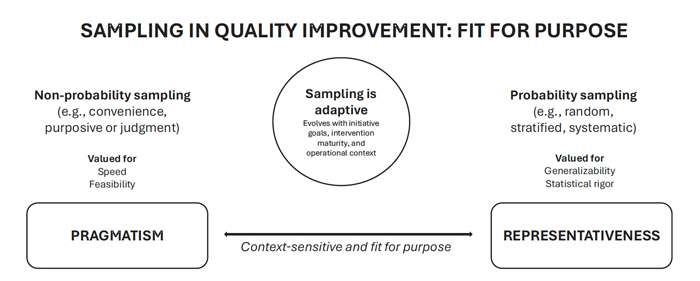
Sampling in quality improvement: Fit for purpose diagram

The review also found that sampling decisions in quality improvement are frequently underreported, inconsistently applied, or poorly justified. Few sources provided actionable frameworks for choosing or justifying sampling approaches. In the absence of fit-for-purpose frameworks, practitioners rely heavily on pragmatic, non-probability approaches shaped by local constraints, which increases the risk of bias, underestimation of variation, and reduced transparency—limiting cross-initiative learning, scalability, and confidence in improvement outcomes.

Sampling decisions have a direct impact on the credibility, interpretability, and applicability of quality improvement findings. The findings of the scoping review demonstrate the need for clearer, fit-for-purpose guidance to support transparent, methodologically sound, and context-sensitive sampling decisions in quality improvement. 

The scoping review, Sampling methods and considerations in quality improvement, is available in Issue 1 for 2026 of JBI Evidence Implementation

connect with us
connect with us
AU Logo
JBI Logo

CONTACT JBI 

JBI
Faculty of Health and Medical Sciences
The University of Adelaide
SA 5006 Adelaide
Australia
+61 8 8313 4880
[email protected]


LEGAL LINKS

CRICOS Provider Number 00123M
Privacy Statement
Copyright

‌ ‌ ‌ ‌ ‌ ‌
SUBSCRIBE to JBI BUZZ