
Quality effects meta-analysis in Stata
A practical guide to bias adjustment using methodological quality assessments
Meta-analysis is widely used to synthesise effect sizes across studies, yet conventional models do not address bias arising from systematic error.
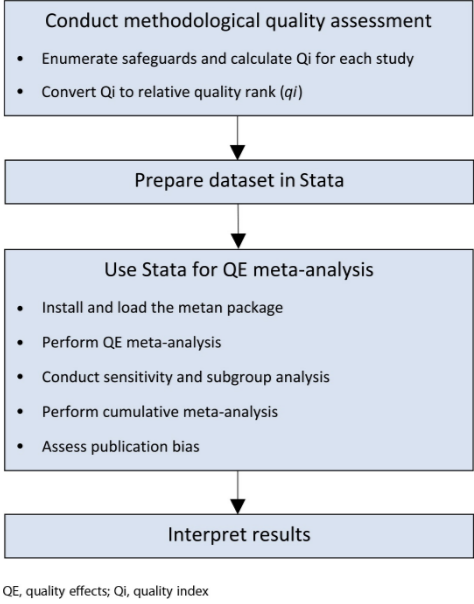
A new article published in JBI Evidence Synthesis, Bias-adjusted meta-analysis using the quality effects model: a Stata tutorial, focuses on one response to that problem: the quality effects (QE) model, a bias-adjusted approach that uses methodological quality assessments to modify pooled estimates. The paper shows clearly and practically, how this model can be implemented in Stata using the metan package and includes:
From methodological quality to pooled estimates
The article takes readers through the full process. It begins by outlining meta-analysis models with and without bias adjustment, then explains how methodological quality is assessed and how those assessments are translated into a quality index and a relative quality rank. From there, it sets out the steps required to run a QE meta-analysis in Stata.
Two illustrative examples anchor the tutorial, chosen to cover both dichotomous and continuous data. Because methodological quality had already been assessed in the original studies, the examples can concentrate on how bias adjustment is applied in practice. The paper also extends beyond the initial model fit to consider subgroup and sensitivity analyses, cumulative meta-analysis, publication bias, and the interpretation of findings.
What makes this paper especially useful is its practical orientation. Although the QE model is increasingly cited in the medical literature, guidance on its application has remained limited. By providing a step-by-step, example-driven tutorial for Stata users, this article fills a clear methodological gap.
The Stata tutorial is available in the special methodology issue of JBI Evidence Synthesis.