JBI Colloquium 2025
Exploring diversity in healthcare, unity in evidence
The JBI Colloquium 2025, with the theme ‘Diversity in Healthcare | Unity in Evidence’ brought more than 220 delegates from over 30 countries to Kochi for three days of discussion and debate on evidence-based healthcare, context-responsive research, and the role of traditional knowledge systems.
Sponsored by Wolters Kluwer and hosted for the first time in India by the JBI Amrita Centre for Evidence Synthesis and Implementation, the event was held at Le Meridien, Kochi, in partnership with JBI Evidence-Based Indigenous Health India from 19-21 November.
The colloquium was formally opened by Professor Zoe Jordan, Executive Director of JBI at Adelaide University; Professor Chandrashekar Janakiram, Director of the JBI Amrita Centre; with Dr Raman Krishna Kumar Clinical Professor and Head of the Department of Paediatric Cardiology at Amrita Institute of Medical Sciences Amrita Vishwa Vidyapeetham as guest of honour.
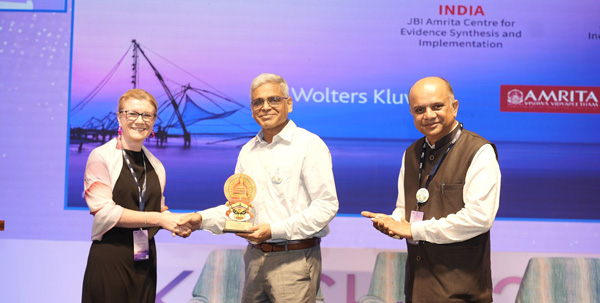
From Day One, JBI Colloquium delegates were challenged to rethink what counts as evidence, who gets to generate it, and how it becomes meaningful in practice.
Plenaries for the three days began with an exploration of ‘Traditional Medicine & Evidence-Based Healthcare Integration’. Dr Kaushik Chattopadhyay, Associate Professor in Evidence Based Healthcare at the University of Nottingham, presented on an evidence-based clinical practice guideline for Ayurvedic practitioners managing type 2 diabetes in Nepal. Dr Rammanohar Puthiyedath, Research Director at Amrita School of Ayurveda, focused on the role of Ayurveda in integrative medicine.
A feature of the program was a paired plenary delivered by Ella Flemyng, Head of Editorial Policy and Research Integrity at the Cochrane, and Hemant Rathi, Co-Founder and CEO of EasySLR, who represented different perspectives on the emerging AI applications for evidence synthesis.
Flemyng, is the Convenor of the joint Cochrane, Campbell Collaboration, JBI and Collaboration for Environmental Evidence (CEE) AI Methods Group emphasised the need for transparency and responsible use of AI tools. She urged AI tool developers to disclose information about how algorithms work and how data are used. Flemyng drew attention to the position statement by Cochrane, Campbell Collaboration, JBI and CEE on responsible use of AI by evidence synthesists and called for developers to ensure their AI tools adhere to the RAISE recommendations so that evidence synthesists have clear, transparent, and publicly available information to inform decisions about whether an AI system or tool could and should be used in evidence synthesis.
Rathi, speaking from the perspective of an AI tool developer for evidence synthesis, discussed the evolving role AI can play in improving efficiency in evidence synthesis. He outlined the current challenges in evidence synthesis, reiterating Flemyng’s statements around evidence synthesis as “too slow, too siloed, and too expensive,” and that AI tools for evidence synthesis can present opportunities to address those challenges. Together, their sessions framed AI as both an opportunity and a responsibility, juxtaposing the promise of faster processes with the need to safeguard trustworthiness of evidence syntheses, transparency, and ethical practice by synthesists and developers.
Plenary speakers emphasised the importance of context in evidence. Nasreen Jessani, Head of the Knowledge, Impact and Policy Cluster at IDS, UK and Associate Professor at Stellenbosch University urged participants to recognise context as central to evidence. Jessani explained how the current evidence monoculture reinforces inequity at every stage, and pointed out the need to reshape traditional evidence hierarchies into mosaics, and engage authentically with all relevant voices.
Lynn Hendricks, Associate Professor at Stellenbosch University, posited imagination as a scientific tool for bridging the disconnect between lived reality and research systems, emphasising that evidence is not merely data, but lived experiences in diverse contexts.

Promise M. Nduku, stressed that evidence systems must be designed for the ‘real-world’ constraints of low-resource settings as he delivered the ‘inconvenient’ truth: “When the floor is falling, gold-standard evidence can be unusable.” His central takeaway was simple: evidence systems must be built for the world as it is, not the world we assume exists. Equity in evidence-informed decision-making means honouring local knowledge, recognising contextual constraints, and investing in the infrastructures that make evidence usable.
Esperanza Martinez, Professor of Practice and Head of Health and Human Security at the Australian National University, argued that research prioritisation needs reframing so that it is purpose-driven, context-responsive, policy-aligned and, above all, people-centred: “Reframing research prioritisation begins with thinking about 'What matters most now, to whom, and what are consequences of not knowing or not acting?'”
In addition to plenary sessions, the program included workshops; oral presentations thoughtfully programmed into specially themed sessions; fireside chats and panel discussions; and dedicated networking opportunities. Delegates praised the quality of the scientific program, with one commenting: “This year’s theme “Diversity in Healthcare, Unity in Evidence” felt alive in every conversation, workshop, and shared moment.”
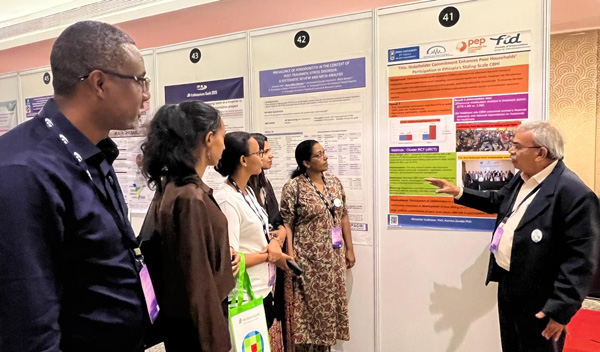
Kylie Porritt, Chair of the Scientific Committee and Transfer Science Director at JBI, acknowledged the work of the organisers and noted that the program enabled deep engagement across cultures and disciplines: “With the theme “Diversity in Healthcare | Unity in Evidence”, we embarked on a truly energising journey. This past week has reminded me how fortunate I am to be working with a passionate global community committed to a shared goal. I leave Kochi feeling privileged to have been both a participant and a contributor to this gathering, energised and determined to translate our discussions into meaningful impact.”
The calibre of the scientific program was matched by the cultural program, which was, at times, spectacular, and always educational and entertaining:
“The cultural program was truly magical. Traditional Kerala music, dance and storytelling brought to life the very themes we discussed all week — plurality, tradition, adaptation, and the power of community knowledge. The hospitality of our hosts was warm, generous, and deeply grounding., offering delegates an opportunity to experience local forms of music, dance, and storytelling” said Bianca Pilla, Global Relations Director at JBI.
Delegates commented widely on the hospitality they experienced throughout the Colloquium. One delegate reflected: “The conference environment was warm, welcoming, and truly inclusive. Every session encouraged open dialogue, and the cultural hospitality of Kochi made the entire experience feel collaborative.”
Professor Chandra Janakiram, Director of JBI Amrita Centre for Evidence Synthesis and Implementation, host of the JBI Colloquium 2025 said: “With this event, JBI's footprint in India has grown significantly, especially with its holistic methodologies providing end-to-end solutions for evidence synthesis and implementation. JBI Amrita Centre for Evidence Synthesis and Amrita Vishwavidyapeetham were honoured to host this colloquium.”
Professor Zoe Jordan, Executive Director of JBI issued a heartfelt thanks to all involved in the JBI Colloquium 2025:
“To our hosts in Kochi, thank you for your warmth, hospitality, and exceptional organisation. To our incredible JBI team, your commitment behind the scenes made this week seamless, enriching, and truly memorable. My heartfelt thanks also to every presenter, facilitator, panellist, and delegate. Your insights, questions, and reflections created one of the most engaging and energising Colloquia we have ever experienced. The theme “Diversity in healthcare | Unity in evidence” came to life through your contributions, demonstrating the power of bringing together diverse voices to improve health outcomes for all.
Awards and Research Highlights
Best Oral Presentation
Domain 1 - Priyanka Yadav - Self-perceived Role of Traditional Healers in the Healthcare of Tribal People in Central India: A Qualitative Descriptive Study
Domain 2 - Emma Wilson - It's not all PINK! Check Yourself, Check The World! Breaking down the barriers and disrupting the global inequalities in Breast Cancer care
Domain 3 - Lyndsay Alexander - Evidence integration to inform practice and guideline development - a Scottish example
Domain 4 - Claire Stansfield - What information resources support the identification of grey literature? Are mega open search engines useful?
Domain 5 - Alexa McArthur - Contextualising quality indicators for pragmatic, clinical implementation in healthcare settings
Overall winner for best oral presentation was awarded to Lyndsay Alexander.
Best poster
Anaswara Das P V - Exploring the contextual needs and feasibility of implementing a maternal and child oral health education programme through Anganwadi Workers in Kerala: A qualitative study
Best Workshop
Sonia Hines - Navigating the Path to Publication: A Workshop for Authors New to Systematic Reviews
Sponsor, organisers and exhibitors
Sponsored by Wolters Kluwer
Local host: JBI Amrita Centre for Evidence Synthesis and Implementation
Organising partners:
JBI Amrita Centre for Evidence Synthesis and Implementation and JBI Evidence-Based Indigenous Health India
Exhibitors: Wolters Kluwer, EasySLR, JBI Amrita Centre for Evidence Synthesis and Implementation