
Implementation science
A promising way forward or part of the problem?
Implementation Science (IS) is not fulfilling its promise of reducing the research-practice gap 'so that effective interventions are delivered successfully in real-world settings'. Perhaps most telling is that Implementation Science (IS) has created its own research-practice gap. By demarcating implementation science from implementation practice, a new gap has arisen. Given that 'implementation' and 'practice' are synonyms, it is difficult to understand the logic behind this distinction.
There is an asymmetry between researchers and practitioners, which may be the primary reason for a research-practice gap. However, this asymmetry is being perpetuated, and not corrected by IS. The asymmetry is evident in statements such as 'to address the gap, scientists have developed strategies to support implementation' as well as calling the gap a 'knowledge-practice gap' as though knowledge was situated on only one side of the divide. At every stage, it is the researchers who control the narrative.
Related to this asymmetry is the implicit assumption that researchers produce the evidence, but it is the practitioners' failure to apply it accordingly that has produced the research-practice gap. There seems to be little appreciation that part of the problem could be the way we have defined what is credible evidence. It has generally been the case that only evidence generated from randomised controlled trials (RCTs) is considered 'gold standard'. Although RCTs produce evidence under ideal conditions, this evidence is, for the most part, not ideal for improving service delivery in real-world contexts.
To create a more seamless interplay between research and practice, a new approach is needed. It would be helpful to revise our ideas on research and hierarchies of evidence. The JBI FAME approach (Feasibility, Appropriateness, Meaningfulness, and Effectiveness) could be useful. In this regard, distinguishing between activities labelled as research, evaluation, audit and quality assurance is not as helpful as promoting the systematic use of data collected in routine clinical practice to inform and improve service delivery.
New training and workforce models could ensure researchers spend time in health services to improve the collection and use of the data that are routinely collected in clinical practice. Training and professional models for health professionals could be expanded to encourage the growth of genuine clinician-researcher career pathways.
To improve interventions for the benefit of individuals and communities, it may be that we didn’t ever need to create a science of implementation. Perhaps we’ve been looking at the problem the wrong way. By revising our views about the important questions to ask, what counts as credible evidence, the asymmetry between researchers and practitioners, and workforce and training models, we might arrive at a situation where the data collected routinely during the delivery of services are used in a systematic and organised fashion to ensure services are effective and efficient. At that time, the research-practice gap might become a quirky relic of the past.
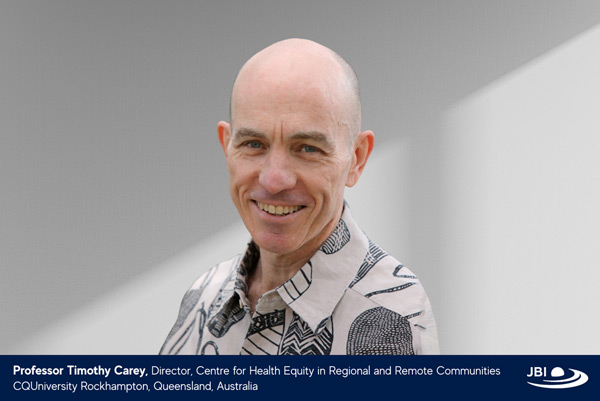
Professor Timothy A. Carey PhD (Clin Psych) | FAPS GAICD CSci
Director, Centre for Health Equity in Regional and Remote Communities,
Office of the Vice-President - Research
CQUniversity Australia
Darumbal Country
Queensland, Australia