
UofA JBI Logo

Main navigation

  • Home
  • About JBI
    • About
      • Work with JBI
      • Annual Reports
      • Our History
    • JBI Model of EBHC
    • JBI Impact Stories
  • Global Networks
    • JBI COLLABORATION
    • GROUPS WE WORK WITH
    • JBI EVIDENCE IMPLEMENTATION NETWORK
    • Scoping Review Network
  • Education
    • Short Courses
      • Rapid Evidence Synthesis: JBI Evidence Summary Workshop
      • Comprehensive Systematic Review Training Program
      • Scoping Review Workshop
      • Evidence Implementation Training Program
      • Evidence Implementation Workshop
      • Clinical Leadership Workshop
    • Postgraduate Research Degrees
      • Doctor of Philosophy
      • Master of Philosophy
    • Tailored Training
  • Products & Services
    • JBI Best Practice
    • Journals
    • Software
    • Consultancy
  • EBP Resources
    • Critical Appraisal Tools
    • JBI Manual for Evidence Synthesis
    • JBI Manual for Evidence Implementation
    • JBI SUMARI Knowledge Base
    • JBI PACES Knowledge Base
    • Research Dissemination Resources
  • NEWS
    • JBI Buzz
  • EVENTS
    • Global Events
    • Solution Room
    • JBI IGNITE
  • Home
  • About JBI
    • About
      • Work with JBI
      • Annual Reports
      • Our History
    • JBI Model of EBHC
    • JBI Impact Stories
  • Global Networks
    • JBI COLLABORATION
    • GROUPS WE WORK WITH
    • JBI EVIDENCE IMPLEMENTATION NETWORK
    • Scoping Review Network
  • Education
    • Short Courses
      • Rapid Evidence Synthesis: JBI Evidence Summary Workshop
      • Comprehensive Systematic Review Training Program
      • Scoping Review Workshop
      • Evidence Implementation Training Program
      • Evidence Implementation Workshop
      • Clinical Leadership Workshop
    • Postgraduate Research Degrees
      • Doctor of Philosophy
      • Master of Philosophy
    • Tailored Training
  • Products & Services
    • JBI Best Practice
    • Journals
    • Software
    • Consultancy
  • EBP Resources
    • Critical Appraisal Tools
    • JBI Manual for Evidence Synthesis
    • JBI Manual for Evidence Implementation
    • JBI SUMARI Knowledge Base
    • JBI PACES Knowledge Base
    • Research Dissemination Resources
  • NEWS
    • JBI Buzz
  • EVENTS
    • Global Events
    • Solution Room
    • JBI IGNITE
 

Breadcrumb

  1. Home
  2. news
  3. article
  4. how automated tools are being used assess healthcare providers nonverbal communication
A clinician uses nonverbal communication with a patient

How automated tools are being used to assess healthcare providers’ nonverbal communication skills

Technology and the therapeutic alliance

The quality of the relationship between a healthcare provider and their patient, known as the therapeutic alliance, has long been associated with better health outcomes, including improved symptom resolution, greater patient compliance, and higher satisfaction with care. A distinct component of this relationship is nonverbal, and measurable independently of verbal communication. 

Eye contact, facial expression, posture, proximity, and voice quality all contribute to the emotional component of the therapeutic alliance, and deficits in these nonverbal dimensions, independent of verbal communication, can worsen patient outcomes.

Measuring such behaviours accurately and consistently is difficult. Survey instruments exist, but they have been criticised for imprecision and rarely identify the specific conduct a provider needs to address. Live observation and video review offer more detail but require considerable human effort to score. A scoping review examines whether technology might offer a more practical alternative.

The scoping review mapped currently available and emerging technologies capable of collecting and analysing provider nonverbal behaviours during healthcare interactions (real or simulated) without requiring constant human oversight. 
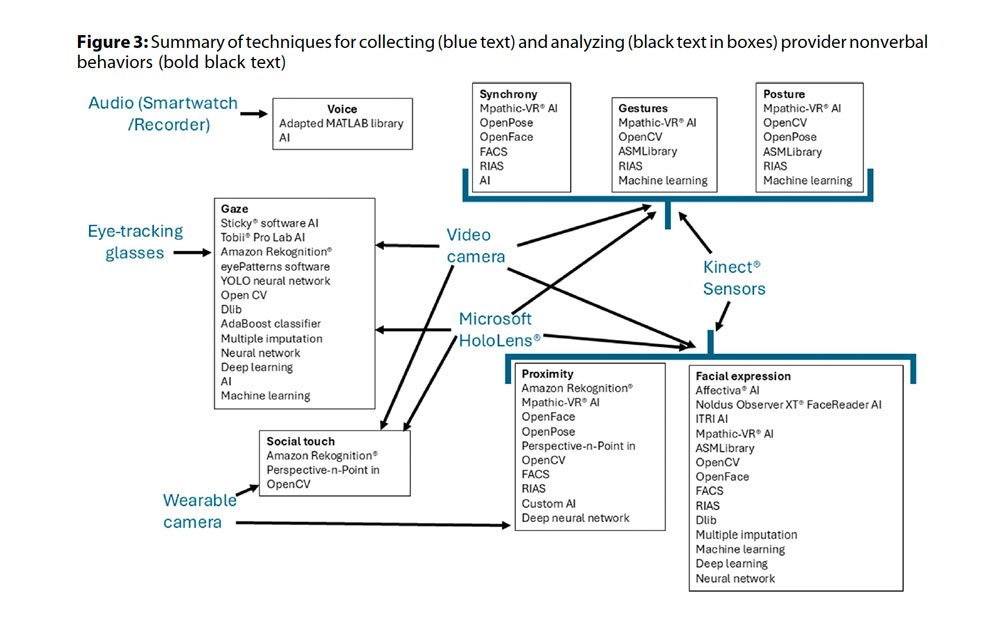
Flow chart diagram of the summary of techniwues for collecting and analysing provider nonverbal behaviors

Where artificial intelligence was employed, the review flags a concern about transparency. Training data for AI models should be openly reported to ensure tools are not applied to populations or purposes for which they are unsuited.

The review is candid about its limitations. The technology landscape is fast-moving, most included studies were at early phases of development, and questions about cultural context, the patient's perspective, and longitudinal effects remain largely unaddressed. 

What the review contributes is a structured account of where the field currently stands: which behaviours are well-served by existing tools, and which present unresolved measurement challenges. The review recommends cautious adoption of technology-assisted methods as they become available and are validated, with more work needed to assess these systems against patient experience across different cultural contexts.

The scoping review, Technology-assisted methods to assess the quality of the therapeutic alliance between health care providers and patients, is available in the May 2026 issue of JBI Evidence Synthesis.

connect with us
connect with us
AU Logo
JBI Logo

CONTACT JBI 

JBI
Faculty of Health and Medical Sciences
The University of Adelaide
SA 5006 Adelaide
Australia
+61 8 8313 4880
[email protected]


LEGAL LINKS

CRICOS Provider Number 00123M
Privacy Statement
Copyright

‌ ‌ ‌ ‌ ‌ ‌
SUBSCRIBE to JBI BUZZ