Providing the highest quality care with JBI evidence-based resources in Fudan, China

December 2023
Yu Chen1,2,3, Lei Xu1,2,3, Yan Hu1,2,3
1 School of Nursing, Fudan University
2 Fudan University Center of Evidence-Based Nursing: a JBI Center of Excellence
3 Shanghai Evidence-Based Nursing Center
Using immune checkpoint inhibitors (ICIs), such as the programmed death-1 (PD-1) inhibitor and the PD-1 ligand (PD-L1) inhibitor, has become an important means of immunotherapy in cancer patients. Despite the good clinical effects, ICIs have many immune-related adverse effects (irAEs) that may affect multiple organs, including the skin, gastrointestinal tract, and lungs. Immune-related cutaneous adverse events (irCAEs) are the earliest adverse events, with 28% to 50% of patients reporting different degrees of pruritus, rash, and eczema. Management of irCAEs is paramount for patients to increase comfort and improve health outcomes.
Lei Xu, a core staff member of the Fudan University Center of Evidence-Based Nursing, realised that more and more cancer patients were using PD-1/PD-L1; however, nurses did not predict or assess irCAEs in advance, nor did they continuously monitor the irCAEs. Consequently, there was a need to normalize management of irCAEs secondary to anti-PD-1/PD-L1 therapy in cancer patients to improve the quality of care.
Lei Xu and her team used the JBI Model of Evidence-Based Healthcare, the JBI Evidence Implementation Framework and JBI PACES to undertake a best practice project in the medical oncology department at Zhongshan Hospital, which is affiliated to Fudan University. The project aimed to standardize the management of irCAEs secondary to anti-PD-1/PD-L1 combination therapy in cancer patients.
The team used the JBI EBP Database, which is an online resource that provides high quality, relevant and up-to-date evidence to guide health professionals’ decision-making at the point of care. An evidence summary with reference to six high-quality clinical guidelines was found. Based on this evidence, several strategies were implemented, including training for nurses on immunotherapy, irCAEs, and standardized assessment of common terminology criteria for adverse events (CTCAE).
The CTCAE assessment of immunotherapy was integrated into the nursing workflow. Content on irCAEs was also added to the patient education manuals and was posted on public media (WeChat). Nurses monitored the grade of irCAEs every morning. Altogether, 6 nurses and 60 cancer patients participated in the 6-month project. At the end of the project, the compliance rate with evidence-based management of irCAEs reached 100%. Patients’ severity of cutaneous pruritus decreased. The rate of drug treatment for cutaneous pruritus decreased as well. Evidence-based management of irCAEs secondary to anti-PD-1/PD-L1 therapy in cancer patients has now been successfully established in the department as a result of the project.
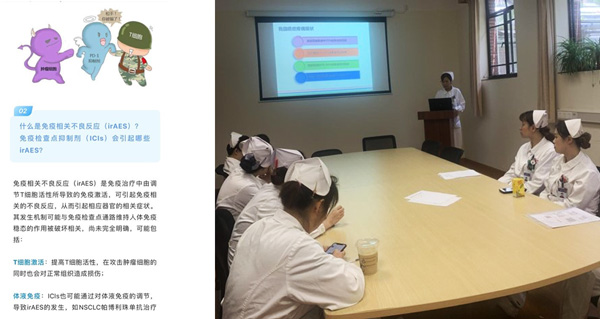
This is one of almost 90 evidence-based implementation projects led or facilitated by Fudan University Center of Evidence-Based Nursing. The center has been committed to building and developing a network platform of evidence-based nursing practice, and accelerating the implementation of evidence into clinical practice. The Fudan EBN Center works closely with multiple hospitals by disseminating evidence-based resources and promoting evidence-based nursing practice. The JBI EBP Database is an integral component to this. The JBI EBP Database is always introduced in detail and is most frequently used.
The JBI EBP Database covers a wide range of clinical topics and includes more than 4,500 evidence-based practice resources (evidence summaries, recommended practices and best practice information sheets) that have been analysed and appraised by expert reviewers across the globe. Using these resources in clinical settings enables organisations to seamlessly integrate EBPs and empowers health professionals to bridge the quality and safety gap by using the latest evidence in clinical decision-making.
The JBI evidence summaries are short, comprehensive and concise abstracts that summarise existing international evidence for specific clinical care practices. The summaries, which are updated annually, contain a clinically-focused question, a brief summary of key points of evidence, an overview of the quality and level of evidence, and a series of key recommendations. Evidence summaries are easy to understand and disseminate. They can help nurses to efficiently understand the relevant evidence, and are especially suitable for the preparation of evidence-based resources before evidence implementation. The summaries have been widely used in the nursing field in China.
“The JBI EBP Database is convenient to use. For example, the Multi-field search, the Advanced search and Search fields in the database are the most frequently used retrieval methods, which can meet different retrieval requirements and find data faster. The retrieval method is easy to learn and use, especially for clinical nurses, who only need simple training to master the retrieval method. This means that clinical staff who implement evidence transformation can use it easily. Moreover, the evidence classification of JBI resources is clear. The database is also updated regularly and the latest evidence can be retrieved.”
The Fudan EBN Center hopes that more JBI resources will be transferred and implemented into more hospitals in China to promote effective and efficient nursing practices, to guide scientific clinical decision-making, and ultimately, to provide the highest quality of care to patients.
Further resources: https://doi. 10.3969/j.issn.2097-1826.2022.08.004